
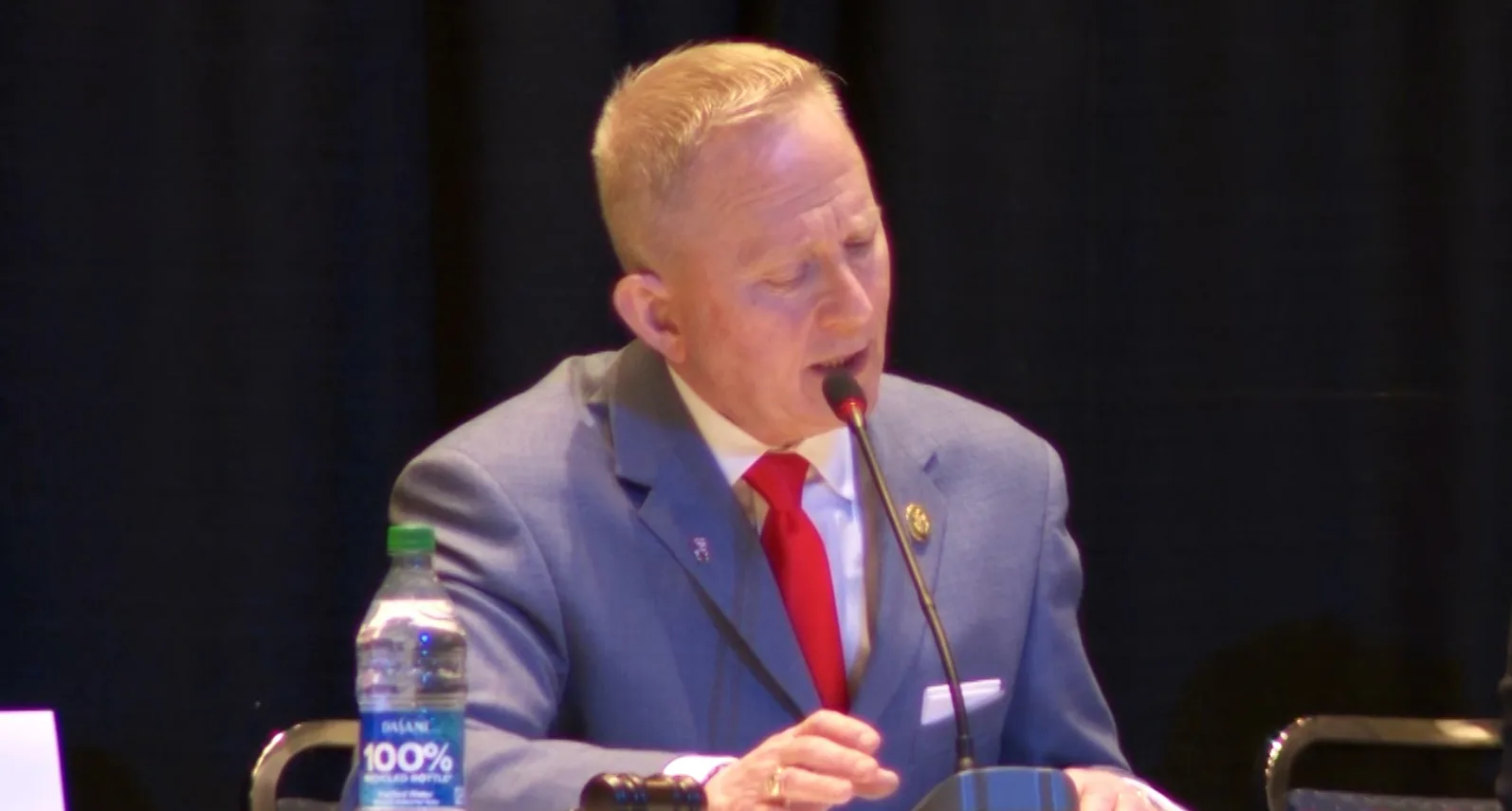
WASHINGTON — It was December 2025, and Jeff Van Drew was trying to broker a deal.
Unless the Republican-majority Congress extended federal tax subsidies, health insurance payments for Obamacare were going to skyrocket in January. The political blowback could end careers.
“We’ve got to try,” U.S. Rep. Van Drew (R-2nd) said at the time, pushing for an 18-month or two-year extension. “I can only do what a human being can do.”
Shuttling between the House floor and the Speaker’s office, the South Jersey congressman worked for weeks as a liaison, bridging far-right members, GOP leadership and Republicans who could lose their seats and their majority.
“This is not a selfish thing,” Van Drew said. “Honest to God, I know this is really friggin’ hard to believe, I’m worried about my colleagues. I really do care about them. There’s a lot of good people who won by one, two, three or four points.”
Van Drew, a cowboy boot-wearing dentist and former state lawmaker who infuriated Democrats when he switched parties in 2020, was defiant. He would win in 2026, he said. A lock. “I won my last election by 18 points. The election before that by 17 points,” he said. “I’m going to be okay.”
Jump ahead a year, and Van Drew may not be feeling quite so confident.
In the waning days before Election Day, Democrats have put muscle, manpower and money into proving the 73-year-old’s prediction wrong. U.S. Sen. Cory Booker (D-NJ) and fellow Rep. Donald Norcross (D-1st) stumped in the district for Van Drew’s opponent, Zack Mullock, the mayor of Cape May. Outside money, including from the powerful New Jersey teachers’ union, has started to flow (opens in new tab) to help Mullock. A liberal super PAC is spending $1 million against the incumbent.
It wasn’t always this way. This summer, the lone seat Democrats were targeting in the state to flip was New Jersey’s 7th Congressional District, which Rep. Tom Kean Jr. represents.
But buoyed by the results of Gov. Mikie Sherrill’s campaign for governor in 2025, when she came within single digits of carrying Van Drew’s district, national Democrats took notice this month.
Suzan DelBene, the head of the Democratic Congressional Campaign Committee, the campaign arm of House Democrats, called (opens in new tab) Van Drew a “spineless politician who prioritizes tax breaks for the wealthiest few while gutting health care and raising costs for his constituents.”
Central to attacks against Van Drew is his vote for a tax and spending cut law that slashed funding for Medicaid, the national health insurance system for the poor and disabled, by $1 trillion over the next decade and about $285 billion from food aid in exchange for tax cuts.
“I don’t know how he did that,” Norcross said in an interview after Van Drew’s vote.
The 2nd District was home in 2025 to about 162,900 Medicaid enrollees, or 20% of the population, according to KFF, a nonpartisan health policy research, polling and news organization.
“They’re going to remember that,” Norcross said of Van Drew’s constituents.
‘Not for seniors’
In an interview last year with NJ Spotlight News, Van Drew defended his vote as a way to protect the program for the needy. He said he wants to safeguard against those defrauding the system, not those who are rightfully eligible.
“Not for seniors, not for kids, not for pregnant women, not for young families.” This spring as talk bubbled among Democrats on Capitol Hill about the prospect of redrawing congressional maps to counter redistricting in Republican-governed states, Rep. Bonnie Watson Coleman (D-12th) said Van Drew could be beaten without new maps.
“Van Drew is weak,” she said in a May interview. “If you look at his district, I think we could get it at some point.”
Watson Coleman said of her Republican colleague: “He has a lot of minorities, he has a lot of immigrants. He has a diversity down there that I don’t think he’s paying attention to. He’s got Atlantic City and he’s got Pleasantville.”
Both municipalities have significant populations of Black and Latino voters, Census records show —- more than 60% combined in Atlantic City and greater than 80% in Pleasantville.
“I would show his voting record and pictures of him so close to the president you can smell his cologne,” Watson Coleman said.
Van Drew’s challenger
A two-term mayor, Mullock grew up in the town he now leads, where elections are non-partisan. As of Oct. 22, the last deadline for campaigns to disclose their overall spending before Election Day on Tuesday, Mullock had raised about $855,000, behind Van Drew’s $2.3 million. In the first half of October — crunch time for campaigns — he had brought in about $136,000, federal disclosures show.
At a debate last week at Stockton University, Mullock criticized Van Drew over the economy and his support for U.S. foreign policy in the second Trump administration. “He needs to answer how this war has helped the people of South Jersey,” Mullock said.
In closing remarks, Mullock said, “I want to work with everyone to make sure that we can provide the American dream to all. I leave you with a simple question: Are you better off than you were two years ago?” First elected to Congress as a Democrat in 2018, Van Drew swept into office on an anti-Trump wave during the president’s first term. He has cruised in elections ever since, accruing seniority in the House and emerging as a key ally of and congressional link to President Donald Trump.
More recently, Van Drew spearheaded a congressional push to investigate the voter registration error that led to more than 6,000 New Jersey residents being approved to vote, though 400 appeared to have voted.
“Whose side is the New Jersey governor on?” he said at a recent hearing he called on the topic, adding that a few votes can determine the outcome of an election. “Five votes, ten votes, three votes can make a big difference.”
In Trump’s second term, Van Drew’s influence has been apparent in the White House. The president asked him for input on an executive order to weaken offshore wind farms and offered him a Cabinet position, Van Drew told NJ Spotlight News.
Van Drew switched parties in 2020, a choice he said stemmed from Democrats’ push to impeach Trump. Joined with Van Drew’s vote against certifying the 2020 presidential election results, that switch stirs Democrats’ ire six years later, although that didn’t shock Watson Coleman. “That didn’t surprise me. He’s always been suspect,” she said.
Van Drew and his campaign have dismissed Democrats’ recent efforts against the congressman, fueled with the idea that Democratic turnout will put more conservative seats in play.
“The DCCC has about a third of House Republicans on one of their silly wishlists or another, but Congressman Van Drew doesn’t take anything for granted and will continue to campaign as hard as he always has,” Ron Filan, his campaign manager, said in a statement in early October.
Oddsmakers’ predictions
The Cook Political Report, a nonpartisan campaign handicapper, rates Van Drew’s seat as “solid” Republican. “This seat opted for Trump by 13 points, so a huge wave would have to hit the Jersey Shore to put it in play,” the group said in its latest note on the race.
Political analysts at the Center for Politics, housed at the University of Virginia, last week shifted their forecast of the race from “safe” to “likely” Republican.
But they noted it would take a massive “blue tsunami” to sweep Van Drew from office. And in an interview (opens in new tab) this week with NJ PBS’s Rob Nelson, Steve Kornacki, chief data analyst at NBC News, said the working-class background of “insulates a candidate like Van Drew more.”
In the Capitol complex, Van Drew can be a wildcard, bucking his party on select issues — he and fellow New Jersey Republican Chris Smith helped torpedo an anti-union bill this year — while largely remaining a reliable Republican vote.
“People who got a certain amount in their paychecks would get less. I don’t agree with that,” Van Drew said of his vote against the anti-union bill.
In this Congress, he’s also voted for a Norcross labor bill (“I have lots of good friends that are union”), almost single-handedly tanked a Republican bill to cut Veterans Administration benefits for military veterans, and crossed Republican leaders to amend a transportation bill to prevent the shipment of horses for slaughter into Mexico. “Horses are beautiful animals that have a special connection to human beings throughout history,” he said. “C’mon?! Do we want to eat horses?”
Days out of the midterms, economic, political and historical conditions appear to favor Democrats.
Trump’s approval rating nationally hovers in the low 30s. Americans hold sour views of the economy. And in 22 midterm elections between 1934 and 2018, the president’s party lost an average of 28 House seats, according to the American Presidency Project, part of the University of California, Santa Barbara.
The pattern held in 2022, when Democrats, with Joe Biden in the White House, lost 10 seats.
Speaking at George Washington University in Washington, D.C., in early October, former New Jersey Gov. Chris Christie, a Republican, said his party is likely in for a “shellacking” in these elections. It’s a grim sign for the GOP that Republicans seem to be in close races in traditional Republican strongholds, like states in the Great Plains or the South, he said.
“There’s one thing in losing majorities, and that will be very bad for the Republican Party and the immediate future if the Democrats would take both the House and Senate,” Christie said. “But if, in the process, you lose seats in Texas, Nebraska, Kansas, that’s a whole different level of political trouble.”
In late summer, Van Drew predicted Democrats would build their campaigns around economic woes, gas prices and inflation. Republicans would anchor their races against what he said the Democratic Party foresees as the future of government in America.
“Who will ultimately have the better answer to the economy?” Van Drew asked. ‘[A system] based on some free-market enterprise, or is it going to be a truly socialist model?”
The differences between the parties have not been clearer in decades, he said: “There’s never been such a stark contrast.”