
Who will control Congress after the midterm elections? New Jersey could play a key role in determining the balance of power in Washington.
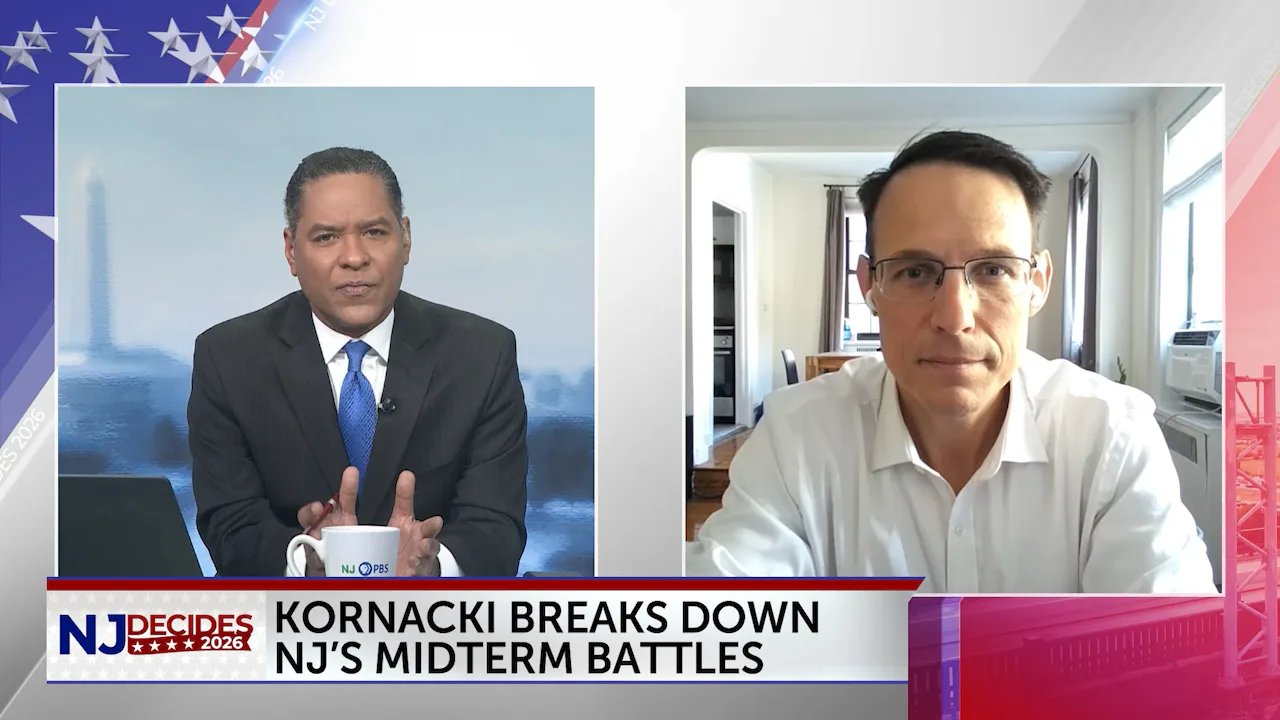
Steve Kornacki, NBC News chief data analyst, breaks down New Jersey’s most competitive midterm races and other pivotal contests across the country.
Transcript:
00:00:00.000] Rob Nelson: With one week now until Election Day, New Jersey could help answer one of the biggest questions in American politics. Who will control Congress starting in January? And few people know how to connect all those numbers to the political map quite like our next guest.
[00:00:16.020] Rob Nelson: You know him for sure. Steve Kornacki is chief data analyst for NBC News, but before he was walking America through Election Night, he was covering politics right here in Jersey, including co-hosting a program on News 12 New Jersey. Steve, good to see you, man.
[00:00:31.820] Steve Kornacki: Thanks for giving us some time. I love getting to do anything New Jersey related, so thank you for having me on.
[00:00:39.280] Rob Nelson: Oh, no, absolutely, absolutely. And listen, you're coming to us from your home office, and so listen, don't worry. If Leslie Jones crawls through your window, I'll let you know. I'll give you a warning.
[00:00:51.760] Rob Nelson: I'll give you a warning. So, listen, you understand the numbers and the dynamics as well as anybody. But because you have such deep reporting roots and a love of Jersey, which we certainly appreciate here at NJ PBS, just big picture for a second before we get into the weeds of the races.
[00:01:08.760] Rob Nelson: When you remember your reporting days here in Jersey and look at the map now, what strikes you as politically interesting, singular, entertaining, or whatever about New Jersey politics? How would you describe our politics to someone? Who doesn't have our history here?
[00:01:25.040] Steve Kornacki: Well, I've always said New Jersey politics is colorful. And colorful meaning a lot of the politicians end up going to jail. But that was a big, you know, the period that I was covering it, sure, there was, you know, Chris Christie was the U.S.
[00:01:40.140] Steve Kornacki: attorney. There was a big, you know, all sorts of, you know, public corruption scandals. But I always say, too, like, I feel like I got a graduate degree in practical. Political science covering New Jersey and my favorite stories and favorite characters.
[00:01:58.560] Steve Kornacki: And honestly, honestly, some of my favorite memories from being a reporter. They are from those years in New Jersey. It's it's you, kind of, get disappointed almost when you step out of the world because it's out of the New Jersey world, because it's just not quite as interesting elsewhere.
[00:02:15.000] Rob Nelson: And now I hear you. It is it is never dull here, to say the least, and certainly not dull in District Seven. These days, either. So this Kean-Bennett race is kind of the one everyone seems to be watching. I will say that what we're seeing, what we're hearing is that Bennett is in a very strong position to flip that seat.
[00:02:36.420] Rob Nelson: So when you look at that district and Kean, listen, has enormous has the power of incumbency, has a last name that is good as gold in New Jersey politics. What are you seeing? What are the numbers saying now in that district? Are we headed for a nail biter or flip here or what's on? What do you see?
[00:02:52.580] Steve Kornacki: Yeah, I think honestly, when you talk to both parties, the you know, kind of given the truth serum, what you hear is it would be a surprise if Kean won. You know, you don't you don't count him out.
[00:03:06.500] Steve Kornacki: But one of the indications would be sort of the national groups coming in on behalf of these two candidates. Some of the Republican money on behalf of Kean has pulled out, you know, suggesting they're seeing something there. And I think you just look at, you know, that district there, you know, sort of Morris-Hunterdon in that area, that part of the state, the political transformation that's been going on
[00:03:32.180] Steve Kornacki: out there. You know, you say what's different from when I covered it, you know, 15, 20 years ago. That's one of the biggest changes. You know, we saw it in the other part of Morris County with with Mejia winning that winning that special election. I mean, you know, a candidate that far to the left winning in Morris County.
[00:03:48.380] Steve Kornacki: Unheard of, you know, before you before now. And so I just Democrats have made huge inroads, I think, in that part of the state. A lot of it's been in response to Trump and the fact that Trump's numbers are as low as they are right now. He's getting particularly low marks on the economy.
[00:04:04.940] Steve Kornacki: You know, Iran, these these sorts of things makes that a difficult place for Kean.
[00:04:09.740] Rob Nelson: No, absolutely. And look, you said the key word there. And it's Trump. I think like much like the last decade plus of American politics, it does fundamentally boil down. To whether people like, love or hate Donald Trump. So in this particular race, is it that Bennett is so, so good and so, so great?
[00:04:26.820] Rob Nelson: Or is it just this Trump backlash that could propel her into office? Is it the national dynamic or the individual candidate driving things?
[00:04:36.140] Rob Nelson: Yeah, look, I mean, I think you just look at Bennett in her background and kind of her bio. And I mean, there's a lot of folks have made the comparison to Mikie Sherrill, you know, who's obviously been a very successful political figure. Again, coming in. Coming from sort of that area, too. So I think I think Bennett is well positioned as a candidate to tap into the broader national climate that we're talking about right here.
[00:04:59.580] Steve Kornacki: And and again, I just our poll has our I should say our average of polls as Trump's approval rating. This is nationally, you know, in the high 30s. And if you went back, like go back to his first midterm, 2018. Remember, in 2018, you had candidates like Mikie Sherrill breaking through and winning districts in New Jersey.
[00:05:17.600] Steve Kornacki: His approval rating then was about five points higher. So it's it's deteriorated some from his first term when Democrats had a very good, you know, midterm there in New Jersey on the House side.
[00:05:29.880] Rob Nelson: And looking at District Two, people talk about Jeff Van Drew. He won by 17 points last time. Former Democrat, now Republican. You know, he seemed very safe. 17 points. You should feel very, very comfortable. There does seem to be. I'm not quite sure whether the numbers bear this out.
[00:05:45.840] Rob Nelson: You tell me. But at least a little more interest. Some some maybe shifting ground in that race a little bit. But I'm trying to decipher between numbers and and wishful thinking by the Democrats here. When you look at District Two, is he in in serious trouble or is that just kind of a talking point for the the chattering class?
[00:06:07.580] Steve Kornacki: Yeah, I look at it more as sort of as I put it in the context of the country. To me, it's a it's a wave test. Meaning. If the Democrats actually flip a district like NJ two with with Van Drew this year, that's a signal that they are flipping all sorts of like double digit Trump districts around the country.
[00:06:28.660] Steve Kornacki: And they're having the kind of night that I think goes beyond what some of the from Democrats optimistic Republicans pessimistic chatter is about the state of things right now. I think we talk about like the seventh district, you know, and sort of the demographics and the geography of that area.
[00:06:45.400] Steve Kornacki: It's very different. I think the with with the second district, they're very different down in the second district. They're more blue collar,
[00:06:49.780] Steve Kornacki: more working class. If you remember in in 2021, when Murphy nearly lost the governorship to Chiarelli, that part of the state was sort of where the red wave of 2021 really hit there. And I think there's been what what resonates in a district like NJ seven. It works a little different, I think, in NJ two and I think it insulates a candidate like Van Drew more.
[00:07:16.260] Rob Nelson: Such an interesting point, and we certainly will see Tuesday night how it all plays out. As you well know, one of the more fascinating subplots of 24 was that President Trump made inroads with working-class voters. He made inroads with Hispanic voters as well.
[00:07:35.100] Rob Nelson: We have a large number of Hispanic voters here in Jersey, roughly one in four, and the reports now of that support from two years ago has eroded quite a bit, and you can imagine state of the economy, the immigration crackdown. Talk a little bit how you think that may play out in Jersey and around the country, your numbers showing that kind of support slippage in those two communities as well.
[00:07:59.940] Steve Kornacki: Yeah, I mean, in fact, we already saw that in New Jersey last year in the governor's race. Some of those heavily Hispanic areas where Trump made the massive gains in 2024 largely unwound for Republicans in the governor's race in 25. I think the fact that if you look at Jersey right now, Nellie Pou, the fact that she's widely expected to be reelected, the national parties have not come in and made that race a priority.
[00:08:24.900] Steve Kornacki: That's a district, a huge Hispanic population that Trump actually carried in 2024, and so on paper, you would look at that and say, she should be a very vulnerable Democrat, but it's a sign, I think, of the degree to which that Hispanic support has eroded in the last year and a half, that that race didn't even really become a priority or a target for the national parties this year.
[00:08:47.660] Steve Kornacki: I do think that two things could be going on, however, which is, you know, that number one, as we're saying, the Hispanic support for Republicans has come back a considerable bit from 2024 levels, but there may also be simultaneously a longer -term story that's playing out here where the floor for Republicans with Hispanic voters is higher now than it was, say, a decade ago, and we may end up looking back, I don't know, 10, 20 years from now, and seeing that there was sort of an uneven, but sort of forward trajectory
[00:09:17.400] Steve Kornacki: for Republicans in terms of winning more Hispanic votes. They may still be on their way to doing that long-term, but this may be the kind of year when there's a bit of a drop-off for them.
[00:09:27.300] Rob Nelson: Wow. Now, what a fascinating dynamic. Really, the pendulum of American politics does swing this way, and you talk to some Republicans, and they say, listen, this is what happens. The midterm is a referendum of the person in the White House, and this is the way it swings, and that's generally true.
[00:09:43.100] Rob Nelson: There's some crazy stat like going back to World War II or what have you, like this is the way it goes, except for two midterms, the party not in power in the White House does better in the midterm. That's kind of the way American politics rolls. So, considering this is kind of what we do traditionally, does this feel any different?
[00:10:02.880] Rob Nelson: You know, is there anything peculiar? About this one, or is this just the pattern being the pattern?
[00:10:09.500] Steve Kornacki: Yeah, I mean, I think it's a lot of that, definitely, and we're seeing that with how like the independent vote is breaking, you know, in the polling at least. The question is, like, does this go beyond what we've seen maybe in some recent midterms?
[00:10:26.380] Steve Kornacki: And I think where the kind of question and where the suspense is here is there's been a Trump-based rally of rural voters, in particular, who swung hard to him in 2016 and have turned out in droves for him, given him overwhelming support for a decade.
[00:10:46.400] Steve Kornacki: I think there are some indications, at least possibly, that that vote is, I don't know, unmotivated, stepping back, you know, is not fired up for Trump and the Republicans this time around. If that were to come to fruition, where through some combination of that vote, not showing up in the numbers it has before, or even in some degree switching to Democrats, that's when districts, yeah, when you talk about like an NJ Two, that's when stuff like that starts to potentially come into play.
[00:11:15.820] Steve Kornacki: I don't know if that's actually happening, and what looms over all of this is, you know, that question of are the polls missing something, because the polls have missed rural voters before, too. But I think that's where the suspense is. I think both parties, again, when you give them the truth serum, they expect this to be a good night for Democrats.
[00:11:32.000] Steve Kornacki: The question is, how good? I think that's the key variable.
[00:11:37.080] Rob Nelson: As someone said, is it a wave, or is it a tsunami, or is it a ripple? We all love this metaphor of the wave, so we'll see which it is, and has the wave been under or overstated? And certainly we'll begin to find out Tuesday night. Along those same lines, kind of touch on the idea of voter enthusiasm.
[00:11:54.200] Rob Nelson: Right now in Jersey, we're seeing really strong early voting, Democrats out to a big advantage, but people caution and say that, too, is a pattern, because typically Democrats come out early. They will go more on the mail-in route. Some of that's now distrust in the post office, which is another interesting facet of the Trump era of American politics.
[00:12:14.700] Rob Nelson: But they say Republicans like to go on Election Day itself. They're going to be out there in the line on the 3rd. Is that generally true? We shouldn't read too much into a Democratic advantage based on the data we have so far from these first few days of early voting in person?
[00:12:30.980] Steve Kornacki: Yeah. Yeah, I mean, it's definitely true that this split that we've seen, you know, where the Democrats have been more likely certainly to do mail, generally to vote early, and the Republicans have been more eager to show up on election day. I know there's been messaging from Trump and from Republicans trying to encourage the Republican vote, to vote early more. They've sort of shifted their tone on that
[00:12:52.700] Steve Kornacki: in the last election cycle or two. You know, I don't, I'm very hesitant about reading too much into the early vote data, because there's no way of getting around the fact that it will always be incomplete. And we will never have the complete
[00:13:06.300] Steve Kornacki: picture until we know who showed up Election Day. So it's always possible that, you know, the party that looks like it's not turning out in early voting ends up swamping the polls on election day. So the only thing that I really say from the early voting that I've seen so far, I think it just confirms what we've seen in polling, we've seen in special elections, we've seen in a number
[00:13:24.620] Steve Kornacki: of other places. It's just there is a core, a segment of the Democratic Party that is particularly motivated right now, particularly motivated to turn out. And so, you offer a chance to cast your ballot three weeks early or whatever. Those voters are the most likely to take advantage of it.
[00:13:42.880] Steve Kornacki: But it doesn't mean that the Republican vote doesn't just show up on Election Day.
[00:13:46.920] Rob Nelson: Right. True, true, true, true. Let me ask you one more thing before we let you go. And I appreciate you being generous with your time. Just stepping away from New Jersey, which is hard to do, but we'll step away from Jersey. Briefly enough, what are the one or two other races around the country that you really think will be bellwethers for how to Tuesday progresses?
[00:14:05.540] Rob Nelson: Is it Talerico and Paxton in Texas? Is it the race in Maine? Is it the race in Michigan? What else are you really going to be zeroing in when you're on the air Tuesday night to see what America's really going to do?
[00:14:19.560] Steve Kornacki: Yeah, I think Texas is a good test, you know, because Democrats have been talking for 30 years about trying to win statewide in Texas. They've been pointing to some demographic shifts in the state that they think will long term, you know, make them competitive in it.
[00:14:34.820] Steve Kornacki: And in this environment, you know, against the candidate, you know, Ken Paxton, the Republican there, who's got very high negatives. If Democrats can't take advantage of that in Texas, you know, I think that could be an indicator, you know, of maybe not quite reaching their potential on election night this year.
[00:14:55.500] Steve Kornacki: And meanwhile, on the Republican side, the one I'm interested in is Michigan, because I've got all these places where Republicans are on the defensive. But in Michigan, they're looking to flip. A Democratic-held Senate seat. And I think there's a lot of volatility in that race. It's very, you know, it's a unique situation. Democrats nominating a candidate, you know, so far to the left in a state that Trump won two times.
[00:15:15.460] Steve Kornacki: And so that's another one I'm looking at right away, because Republicans, if they could win a state like Michigan, it would significantly change the math when it comes to Senate control. And it would make the path for Democrats, which is already tricky. It would make it very, very hard for them.
[00:15:30.920] Rob Nelson: Excellent exclamation point to leave things there. Well, I mean, look, for someone who is so good at what you do in millions turns you to kind of walk us literally county by county through America on election night. When we're less than a week out now, is it more fun for you?
[00:15:48.200] Rob Nelson: Does it get stressful? Does it get intense? You got the big board and all the facts that are in your head. How do you feel just about getting ready for that for that big night and all the pressure and eyes that are on you and the folks who watch your network?
[00:16:04.820] Steve Kornacki: Obviously, I am excited. Yeah, elections is just that, you know, I love getting the experience watching the returns come in and the map take shape and all of that. But yeah, there's a ton of anxiety, too, because it's just the more the more that I've done this, I think the more I become aware of what I don't know.
[00:16:20.240] Steve Kornacki: And I think maybe earlier on there was there was there was some serenity in in ignorance.
[00:16:28.900] Rob Nelson: That is a that is an unsurprisingly humble answer, Steve. You're very good at what you do. And I can't wait to see what you do next. I can't wait to watch you on election night once our special coverage is over. But you've you've made data analysis and politics and big boarding cooler than anybody else in the business.
[00:16:47.120] Rob Nelson: And it's a pleasure to have your time and to and to watch you do what you do best. So thanks for letting us have a sneak peek at that today and some insight on this really interesting election season. We appreciate it.
[00:16:57.760] Steve Kornacki: Wow. Really nice. I appreciate that. And great to be with you.
[00:17:00.940] Rob Nelson: Absolutely. All right. NBC's chief data analyst. Steve Kornacki, the one and only. Thanks for being with us again, sir. And as always, you can get more of Steve's reporting and is seemingly around the clock analysis on NBC News, NBC News Now and NBCNews.com.
[00:17:16.660] Rob Nelson: And if you really want the Steve deep data dive, you can always subscribe as well. And of course, we'll have our own election coverage at the same time on Election Day and night here on air and also on NJPBS.org. So tune in as we cover NJ Decides 2026.
[00:17:32.700] Rob Nelson: What is driving voters to the polls? What it means for our state, for the country and for, of course, control of Congress?