
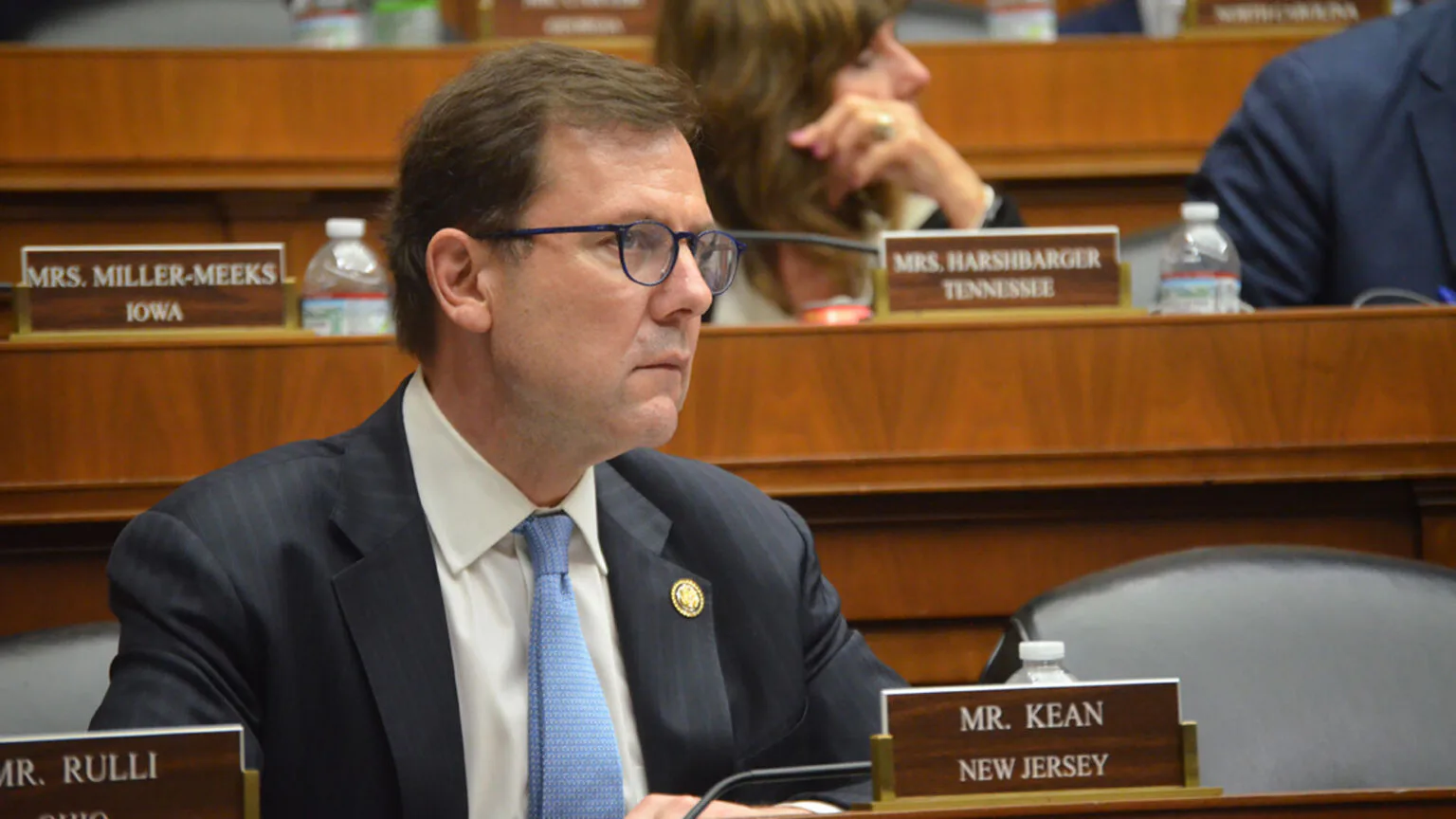
WASHINGTON — One day after Tom Kean Jr. revealed he had disappeared for months from his job on Capitol Hill due to his treatment for depression, the New Jersey congressman filed legislation to require health insurers to provide the same level of coverage for mental health and substance-use disorders as for physical conditions.
That bill — aimed at what is termed “mental health parity” — would empower the Labor Department to issue fines against violators and set aside $30 million for enforcement.
“I have always been a supporter of mental health care. During my time in the New Jersey legislature, I worked to advance mental health parity,” Kean said on the House floor (opens in new tab) in late June. “I believed in the cause then, and I understand it in a far more personal way now.”
Debra Wentz, president and CEO of the New Jersey Association of Mental Health and Addiction Agencies, a trade group, has known Kean for years. “I think that this was even harder for him than it might be for somebody who’s super outgoing,” Wentz said in an interview with NJ Spotlight News. “For him to do that was huge.”
In the context of Kean’s own experience, mental health has been an outsized -- and at times contradictory -- issue for the congressman for years.
Over a 30-year political career, he pressed for bills to protect and expand services as both a state legislator and congressional one. Yet at the same time, he voted with the Republican majority of Congress to pass legislation that some say could have a devastating impact on mental health services.
Kean, a Republican, has sponsored bills on mental health among children and military veterans this year. In January, he intervened against the Trump administration to block the cancellation of thousands of federal grants at the Substance Abuse and Mental Health Services Administration. And Kean has emerged as one of the few national politicians in U.S. history to reveal their personal struggles with depression.
In his two and a half decades as an elected official, first in the New Jersey state Legislature then as a two-term congressman in Washington, Kean worked with Democratic and Republican governors in Trenton to pass mental-health bills, including measures on gun safety and parity.
“We must do everything we can to support the mental health of our children,” Kean said this month, when he introduced legislation to protect the mental wellbeing of middle-school kids and held an event in Bridgewater. “Conversations like these help us identify meaningful ways to support middle school students so they can thrive both academically and emotionally.”
Still, Kean voted in the legislature against paid leave and cannot claim any significant breakthroughs on mental-health topics in Congress.
Critically, Kean defended his vote for a federal law that could remove an estimated 10 million (opens in new tab) Americans from health insurance coverage in the next decade, including for mental health services.
Passed in the summer of 2025, the law requires people to prove they work, volunteer or are in school for at least 80 hours per month if they want coverage through Medicaid, the federal health insurance system for low-income adults and children, plus the disabled.
That provision of the law would apply to more than 540,000 adults in New Jersey, according to the state Department of Human Services. Called NJ FamilyCare in the state, Medicaid covers more than 1.85 million people in New Jersey, according to state data. Early data from states that have begun to carry out the law show patients enrolled in Medicaid have fallen off.
Reyna Taylor, vice president of public policy and advocacy for the National Council for Mental Wellbeing, said the number of patients who fall out of the system will likely be “exponential.”
“Once we get into 2027, 2028 and then by 2029, we’re going to start seeing millions losing coverage,” she said in an interview with NJ Spotlight News.
“H.R. 1,” Taylor said, using the name of the bill, “It’s going to affect our entire nation.”
Kean has said he voted for the bill to safeguard Medicaid against fraud and for the people it’s meant to benefit. On the campaign trail running for reelection, he has said little, if anything, about the potential cuts in mental health services.
“Medicaid provides both physical and mental health services and is the nation’s single largest payer for mental health and substance use treatment, funding a wide range of services -- from primary care screening and counseling to treatment for opioid use disorder and postpartum depression,” according to a report (opens in new tab) by advocacy groups Inseparable and Mental Health America.
Relatively few national politicians have disclosed histories with depression or mental wellbeing as Kean did this year.
Over the last half-century, former U.S. Sen. Thomas Eagleton, a Missouri Democrat running for vice president in 1972, withdrew from the race after his struggles with depression and related hospital stays were revealed. Sitting U.S. Sen. Reuben Gallego of Arizona and Massachusetts congressman Seth Moulton have spoken openly about their struggles with post-traumatic stress disorder, or PTSD. Both are military veterans. Patrick Kennedy, a former congressman from Rhode Island who lives with bipolar disorder, became an advocate after his time in Congress.
The latest comparison has been with U.S. Sen. John Fetterman, the Pennsylvania Democrat, who shared his history with depression following a stroke in 2022.
“Congressman Kean did something very few public officials have done,” said Wentz, whose group gave Kean an award this year about fighting stigma surrounding mental health.
“When a member of Congress stands before the nation and has the courage to say that he was treated for depression and returns to work, he makes our message more believable to every person who’s still suffering in silence,” said Wentz.
As a Republican leader in the state Senate, Kean worked to broker a bipartisan gun-safety bill during Gov. Chris Christie’s term that included protections for those with mental health illnesses.
When Phil Murphy was governor, Kean was a key sponsor of parity legislation that became law. “Being able to maintain mental health should be no different than being able to maintain physical health,” Murphy said when he signed the bill into law in April 2019.
“This bill truly puts the healthcare consumer first,” Kean said at the time.
Kean’s federal bill (opens in new tab) on parity very closely mirrors legislation U.S. Rep. Donald Norcross (D-1st) has introduced for years in the House. Kean’s bill filed upon his return, in fact, appears to be almost word for word with Norcross’s bill (opens in new tab), filed more than a year before.
“It’s been something that I’ve been focused on and passionate about for years,” Norcross said in an interview with NJ Spotlight News.
Norcross has introduced his parity bill for the last four Congresses, according to a review of congressional records.
The two men talked briefly when Kean got back to Washington, according to Norcross.
“The day that [Kean] returned, he says, ‘I want to work on a bill with you,’ just briefly something on mental health,” Norcross said.
“The fact that he too has found out, quite frankly the hard way, how critical this is to people, is wonderful,” Norcross said. “If this moves it forward, it’s not about me or him, it’s about those getting the help. However it gets there, I’ll be happy to see it.”
Kean, who famously avoids the press in the Capitol, was first elected to Congress in 2022 and faces a tight election campaign against first-time candidate Rebecca Bennett.
When asked at a September debate about the scant information Kean provided during his months-long absence, the congressman said he was “very transparent” with the public.
“Nobody can plan a medical emergency,” Kean said. “And that was a medical emergency.”
Bennett wished him a “continued speedy recovery.”
But Kean’s record on the issue has not always been consistent. In the state legislature, Kean voted in 2018 against legislation, which became law, to mandate five paid sick days for workers in the state. He also voted against bills to limit surprise medical bills and two family leave bills, as the investigative magazine Mother Jones reported (opens in new tab).
In interviews with NJ Spotlight News, Reps. Jeff Van Drew (R-2nd), Herb Conaway (D-3rd) and Nellie Pou (D-9th) could not recall Kean as a significant legislator on mental health topics. Each served in the Legislature during Kean’s time in Trenton.
Rep. Analilia Mejia (D-11th), a former political organizer and staffer to U.S. Sen. Bernie Sanders’ 2020 presidential campaign, recalled Kean was against paid leave.
“We worked on it for years and he was not a supporter,” Mejia said in an interview with NJ Spotlight News.
“I’m glad that he has a job in which he could take time to care for himself. We all should,” Mejia said. “I’m fighting for the American people to have the same.”