
A little over two years after state policymakers created a long-sought source of dedicated tax revenue for New Jersey’s cash-hungry statewide bus and rail agency, advocates say it’s been a resounding success.
As proof, they point to the hundreds of millions of dollars in funding that’s now being funneled each fiscal year into NJ Transit’s operating budget through a surcharge levied on only the top-earning companies doing business in New Jersey.
This fiscal year, it’s providing more than $765 million to support NJ Transit’s $3.5 billion operating budget.
“It has done exactly what was advertised,” said Peter Chen, president of New Jersey Policy Perspective, a Trenton-based think tank that lobbied for the establishment of the tax in 2024.
“It’s a win-win for the state,” he said during a recent interview with NJ Spotlight News.
But not all agree, and Republicans are pushing for the early expiration of the fee, as it is not written permanently into state tax law. The corporate transit fee is set, by law, to expire at the end of 2028, unless the governor and lawmakers take action to extend it.
Some lawmakers want to repeal the corporate transit fee by the end of this calendar year as part of a broader response to concerns that New Jersey is losing its business edge amid a series of high-profile corporate departures.
“Right now, New Jersey’s business taxes are among the highest in the nation,” said Sen. Michael Testa (R-Cumberland) during a recent interview with NJ Spotlight News.
“That’s putting us at a serious disadvantage when it comes to attracting new employers and retaining existing businesses here,” Testa said.
Testa is the primary sponsor of bipartisan legislation that would both repeal the corporate transit fee at the end of this year, and lower New Jersey’s overall corporation business tax rate.
A Murphy budget legacy
The link between NJ Transit and the corporation business tax was first established in 2024, when then-Gov. Phil Murphy worked with lawmakers to come up with a way to address a large projected gap between the mass-transit agency’s revenues and projected expenditures.
At the time, NJ Transit was facing a host of rising costs, including those related to employee contracts and general inflation, just as significant federal aid the agency received during the COVID-19 pandemic was on the verge of lapsing.
NJ Transit has traditionally received funding transfers from the New Jersey Turnpike Authority and the state’s Clean Energy Fund, but transportation advocates had long-called for the establishment of a dedicated source of state revenue to put the agency on more stable financial footing.
They seemingly got their way when Murphy, a Democrat, enacted legislation in mid-2024 that established the temporary fee to be paid by companies with taxable net income over $10 million allocated to New Jersey.
The same law made the tax retroactive to Jan. 1, 2024, and required it to be levied through Dec. 31, 2028.
In many ways, the corporate transit fee replaced a different business-tax surcharge that had been levied on a temporary basis in New Jersey prior to 2024. But that tax applied to a broader pool of businesses, and it only raised money for the state budget’s general fund, not for any specific purpose.
“This funding will ensure service is maintained as ridership continues to recover from the pandemic while building upon major operational improvements,” the Murphy administration said in a news release issued when the corporate transit fee was officially adopted in mid-2024.
Earlier this year, NJ Transit’s board approved a record $3.5 billion annual operating budget, according to agency documents.
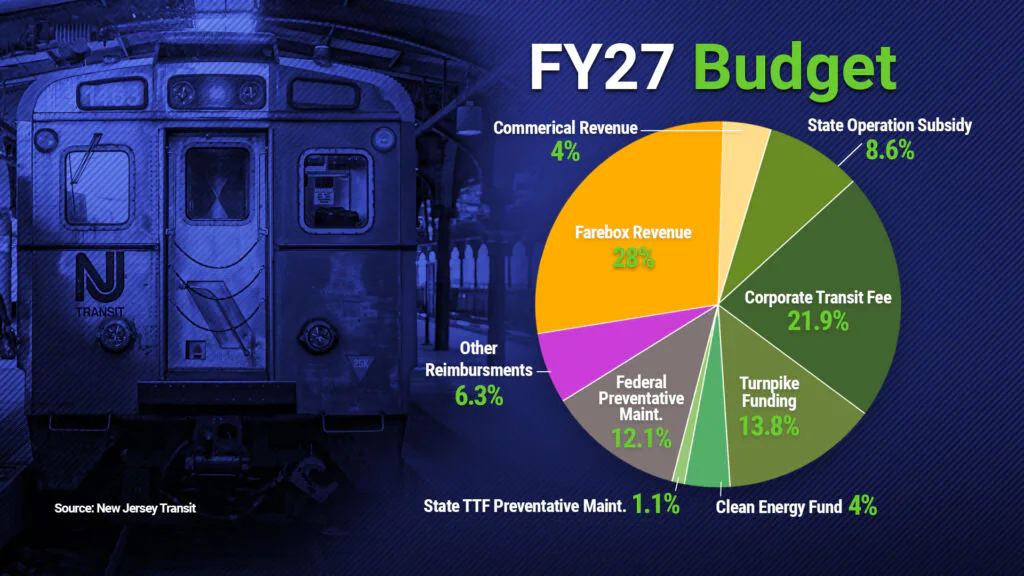
The agency’s fiscal year 2027 spending plan is being supported with more than $1 billion in funding from the state, including $765.6 million in dedicated revenue from the corporate transit fee, according to the documents.
That state support is helping supplement an estimated $980 million in projected rider fare revenue, a total that includes funds from a 3% fare hike that took effect on July 1.
Before the corporate transit fee was enacted, a report issued by New Jersey Policy Perspective noted the proposed new tax would hit only a small group of companies doing business in New Jersey. And major, out-of-state corporations like Amazon, Microsoft and Walmart were likely to be footing much of the bill, the report said.
“Businesses benefit from access to a deep and talented pool of workers, and will often move near job centers served by mass transit as a result,” the report said. “This creates a self-reinforcing loop, making states like New Jersey a great place to live and station a business.”
Amid the recent talk of sunsetting the CTF ahead of schedule, Chen said it should be made permanent.
“This 100% has to be a permanent tax rate,” he said. “There is no replacement for it.”
“When you think about where revenues should be coming from for the state, having them come from the world’s biggest corporations, who are earning money hand over fist – corporate profits are through the roof – this should absolutely be the group that the state is looking to generate revenue, rather than state residents, rather than low- and moderate-income residents,” Chen said.
Sherrill’s non-commital response
Whether Gov. Mikie Sherrill, a first-term Democrat, would agree is uncertain.
Sherrill was asked about the CTF earlier this month after she signed an executive order establishing a plan to improve the state’s business climate. Key members of her administration are charged with looking at taxes and fees and other related policies as part of that effort.
In response, Sherrill pointed to ongoing efforts by her administration to support development of state-owned properties that are adjacent to train stations as a potential source of revenue for NJ Transit.
“We’re getting shovels in the ground as quickly as possible,” Sherrill told reporters in Trenton.
For his part, Testa pointed during the interview with NJ Spotlight News to New Jersey’s poor showing earlier this year in a closely watched ranking of states in the category of business friendliness. In the rankings (opens in new tab) compiled by the CNBC business news network, New Jersey landed 50th out of 50 in that category.
“I believe in the state of New Jersey, I love the state of New Jersey, and we have so much to offer, not just to our residents, but to the Northeast corridor, the East Coast and the rest of the country,” Testa said.
“But we also need to be far more business friendly,” he said.
Asked whether people should have any sympathy for companies banking more than $10 million in profits in New Jersey at a time when affordability concerns are running high across the state for many residents, Testa suggested the issue may be more complicated than it appears.
Many companies reinvest their profits in facilities, increase hiring or decide to pay their employees higher salaries, he said.
“I understand that there may not be sympathy for those companies that are doing well financially,” Testa said. “We also have to ask ourselves, what happens if they choose to leave, because so many businesses are leaving.”
Before you go, a request for help…
NJ PBS is entering a dynamic new chapter; operating out of Montclair State, we're delivering state-of-the-art public reporting while training New Jersey's next generation of journalists, storytellers, and technical leaders alongside seasoned media veterans–in addition to streaming your favorite shows!
Because we operate as an independent entity and can no longer rely on federal subsidies, our strength and sustainability rest directly with you.
Will you join us in building the future of New Jersey public media? Your year-end contribution directly funds our independent newsroom, fuels homegrown Jersey storytelling, and equips future media leaders.
Donate to the NJ PBS Year-End Fund (opens in new tab)