
Economic concerns – led by the high cost of living – are once again shaping voter sentiment in New Jersey, where inflation and the impact of President Trump’s tariffs have been especially painful.
This time around, the affordability issue could be an especially strong factor in the voting that ends tomorrow, especially in some pivotal congressional elections that could help determine the balance of power in Washington.
Coming from both parties, members of the state’s congressional delegation say they are well aware of the economic frustrations that were bubbling over just as voters were preparing to cast their ballots.
And Democrats are especially seizing on the sentiment, seemingly at every turn, that these financial strains are driven by the GOP’s policies. This includes the tariffs on foreign-made goods unabashedly championed by the Republican president.
“Tariff is just another word for a tax,” Rep. Donald Norcross (D-1st) said in an interview with NJ Spotlight News.
“We pay for it,” Norcross said.
For many in New Jersey, it’s the significant rise in gas prices that’s occurred during Trump’s ongoing war in Iran that has emerged as their biggest pressure point. In all, the cost of a gallon of gasoline sold in New Jersey is up by well over $1 a gallon compared to this time last year, according to AAA New Jersey.
Housing costs have also been front of mind. New Jersey’s already elevated rental housing costs have been rising this year at a slightly higher clip than the rest of the nation, according to data collected by (opens in new tab)Apartments.com (opens in new tab).
Some bipartisan agreement has even emerged on housing policy this Congress, and New Jersey’s entire congressional delegation supported (opens in new tab) legislation seeking to increase the U.S. housing supply and speed construction, among other measures.
“Hopefully that’s going to help,” Rep. Jeff Van Drew (R-2nd) said in an interview with NJ Spotlight News. “It’s a very good start.”
Where the candidates differ
Democrats currently hold a clear majority of New Jersey’s congressional seats, 9 to 3 Republicans. But they are in the minority in both the U.S. House of Representatives and Senate – at least for now.
And as it has for years, health care costs have been a prominent talking point. Health insurance premiums for the thousands of New Jerseyans who receive coverage through the state-run marketplace created under the Affordable Care Act, known as Obamacare, are once again on the rise, by nearly 20% starting Jan. 1, according to the latest data released by the state government.
This comes after the Republican Congress chose to allow federal tax subsidies enacted in response to the COVID-19 pandemic to expire at the end of the 2025 calendar year, while it also enacted steep cuts in Medicaid.
Amid this backdrop, New Jerseyans are squarely among those harboring negative views on the economy, according to the latest public opinion polls.
U.S. Rep. Analilia Mejia (D-11th), the newest New Jersey member in Congress, said the economy and political system are stacked against regular people.
“We have a rigged economy and a rigged democracy,” Mejia said in an interview.
Early voting’s surge for Democrats
In New Jersey, early voting began on Oct. 24, with Democrats turning out in higher numbers in many places in the run up to Election Day on Tuesday.
At least one congressional district in New Jersey – the GOP-held 7th district held by Republican Tom Kean Jr. – is among those being closely watched by pundits nationally as control of the House is expected to flip to the Democrats.
But Van Drew’s contest against Democrat Zack Mullock in South Jersey has also emerged as a concern for Republicans as Trump’s popularity has tanked in recent months.
Before Congress left in September to campaign, Van Drew cited delayed work visas for farm workers among his top concerns, saying it was threatening the local agricultural economy in his region of the state.
“The greatest worries were the work visas, and that was something we worked on with the (Trump) administration,” Van Drew said.
He added: “Still didn’t get as many people as they needed.”
Asked if the Iran war could cost him this election, Van Drew — who won his seat in 2024 by 17 percentage points — conceded the war, which began in February, and the ensuing rise in oil prices, are political liabilities.
“I’d either be an idiot or a liar if I didn’t say that. Of course, it’s a concern,” he said.
“The price of oil controls everything. It’s the inflation driver,” Van Drew went on to say. “But this is not the time to cut the legs out from underneath the president. We’ve got to get through this thing.”
Van Drew and Kean, the incumbent Republican in the 7th District, voted (opens in new tab) repeatedly, along with Rep. Chris Smith (R-4th), in support of the war against Iran.
Campaigning in Trump’s – and polls’ – shadows
The trio of Republicans have largely stood in lockstep with the president. Each voted for Trump’s central piece of legislation this Congress, a law estimated to cost $4 trillion that will cut $1 trillion from health insurance for low-income and disabled Americans for a suite of tax cuts, both corporate and personal. They have also stuck with the White House over the Iran war and trade policy.
“The president right now is using [tariffs] appropriately, and I support his use in that regard,” Kean said Sept. 27 during a debate with his opponent, Rebecca Bennett, a first-time candidate. “We’re repositioning our negotiating leverage, and so the president is justifiably doing that to reduce costs to consumers.”
Yet comes at a cost, as Trump’s tariff policy has raised prices an estimated $820 (opens in new tab) per U.S. household this year, according to the non-partisan Tax Foundation.
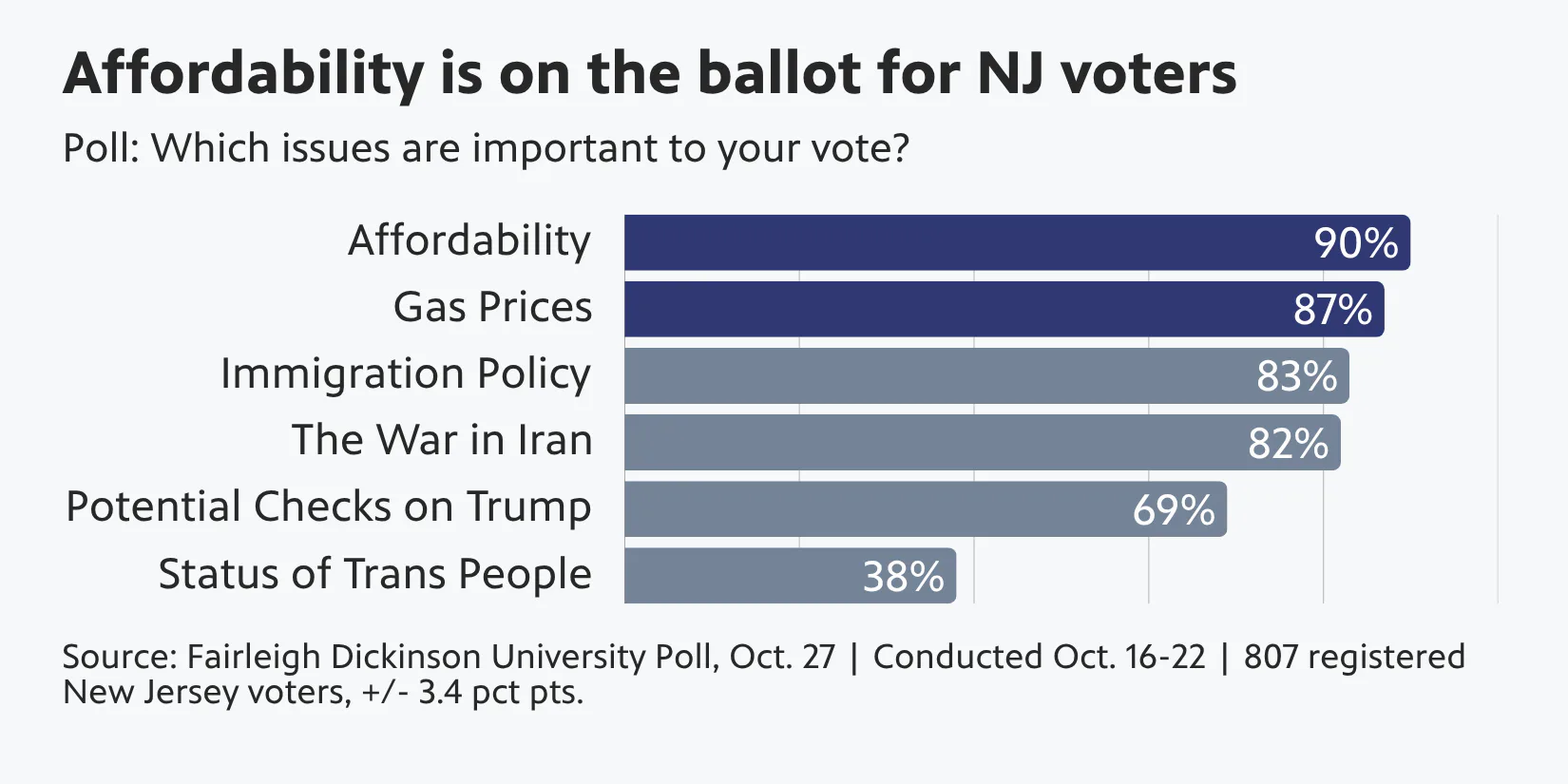
The affordability pains felt by many New Jersey residents this year, including those war-induced higher gas prices, were underscored in the results of a recent Fairleigh Dickinson University Poll.
A full 90% of voters surveyed for the FDU poll said affordability was important to their vote this year, while 87% said gas prices were important to their vote.
And on the affordability issue, 93% of Democrats, but also 88% of Republicans, said it was important this year, according to the poll, which had a +/-3.4% margin of error.
Overall, the FDU poll found likely voters chose Democrats over Republicans running for Congress this year by a 55 to 32 margin.
“There just isn’t any good news to be found for Republican candidates this cycle,” said Dan Cassino, a professor of government and politics who is also executive director of the FDU Poll.
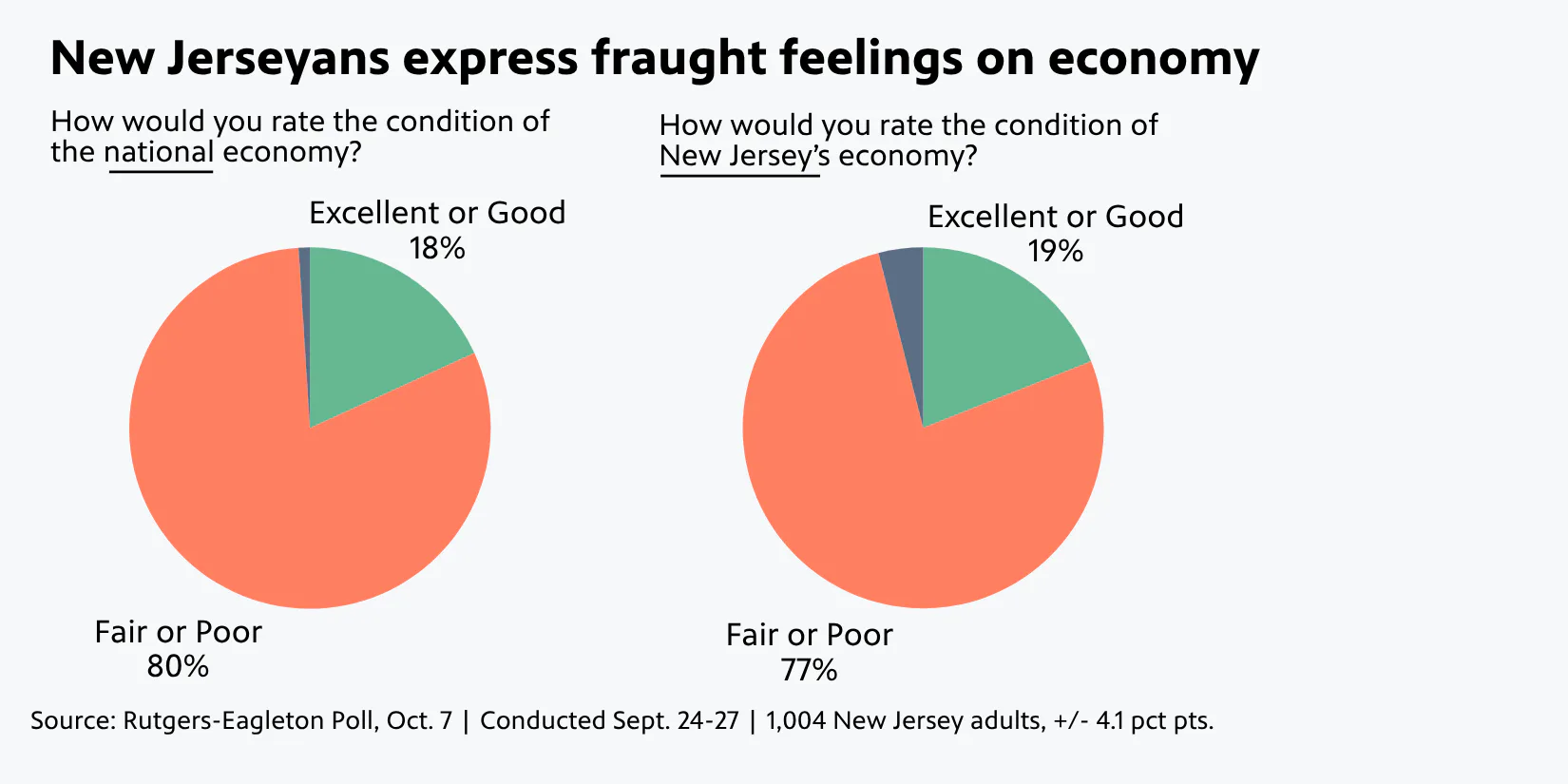
The results of a Rutgers-Eagleton poll released last month revealed additional angst about the economy, with more than 50% of those surveyed rating the national economy as “poor,” which was the lowest grade offered as an option.
Another nearly 30% gave the economy a grade of only “fair,” according to the poll, which had a +/- 4.1% margin of error.
Those ill feelings about the economy were detected at the highest rate among New Jersey residents earning less than $50,000 annually. Still, 45% of those earning over $150,000 annually also graded the economy as “poor.”
“New Jerseyans have been sour on the economy, especially the national one, for some time now, and nothing in these numbers suggests that mood is lifting,” said Ashley Koning, the Rutgers-Eagleton Poll’s director.
Meanwhile, nearly 60% of New Jersey voters surveyed by the William J. Hughes Center for Public Policy at Stockton University in mid-October said the economy has gotten worse over the last year. This included a majority of independent voters, who can play a key role in battleground districts, such as New Jersey’s 7th district.
Only 31% of independent voters approved of Trump’s performance as president, according to the poll, which had a +/- 3.8% margin of error.
Not just in New Jersey
Across the nation, public sentiment is much the same, with 60% of those surveyed in late summer by the Pew Research Center reporting they do not have enough income to live the kind of life they want.
Meanwhile, Trump’s approval rating stood at 32% nationally as of last week, according to the latest Reuters/Ipsos poll.
Typically, this scenario is bad news for the party holding power in Washington, D.C., a notion that was reinforced last year when then-U.S. Rep. Mikie Sherrill, a Democrat, easily prevailed in New Jersey’s gubernatorial election against Republican Jack Ciattarelli.
Only twice since the mid-1930s has the governing party gained seats in the House: in 1998, when Republicans were perceived as too aggressive for impeaching then-President Bill Clinton, and in 2002, when the Bush administration was buoyed by public support in the aftermath of the September 11, 2001 terrorist attacks.
At the 2018 midterms, when Trump’s approval rating was 44, his party lost 41 House seats.
Two years ago, it was affordability concerns that helped put the Republican Trump back in the White House – with more votes cast for Trump in New Jersey than many expected.
But that was before a resurgence in the rate of inflation that’s occurred since Trump’s second inauguration. In more recent months, inflation was running even hotter in New Jersey than the nearly 3.5% rate for the nation as a whole, according to regional data released by the U.S. Bureau of Labor Statistics in September.
The tariffs on foreign produced goods put in place by Trump have cost New Jersey households a combined $14 billion since early 2025, ranking 7th-highest nationally among U.S. states, according to a report published earlier this year by the National Taxpayers Union Foundation. That’s equivalent to $4,031 per household in New Jersey.
“The hardest-hit import category in New Jersey is food and beverages, with an estimated $2.7 billion in additional tariffs paid since January 2025, at an average tariff rate of 9.5%,” the report said.
After Canada responded this year to U.S. tariffs with tariffs of its own, Rep. Josh Gottheimer (D-5th) cited a candy company in his district that is feeling the pain.
“They’re paying millions of dollars more for their business now that they have to pass along,” Gottheimer said.
For many it comes back to gas prices.
In New Jersey, a gallon of gasoline cost about $4.15 as of last week, according to AAA New Jersey.
That marked a big increase compared to the nearly $2.95 cost of a gallon of gasoline recorded in New Jersey this time last year.
Meanwhile, the cost of a gallon of diesel fuel sold in New Jersey has increased from $3.55 to nearly $6.40 over the last year, according to AAA New Jersey, putting a significant strain on the state’s agricultural community, among others.
The public is hurting, Gottheimer said. “It’s accumulative between the tariffs and the gas prices. The gas prices are what people are really flipping out about,” he said.
“There’s so many gas stations, but Wawa prominently displays the price,” Norcoss said.
“That’s as real as it gets,” Norcross said. “My son parked his truck. He drives a little Ford Focus to work now because the gas has just exploded.”