
Despite a significant rise in gas prices triggered by President Donald Trump’s war in Iran, key government officials in New Jersey must soon determine whether a state tax levied on gasoline and diesel sales must be increased.
Under New Jersey law, state government’s top public-finance officials are required to meet each year, by Nov. 15, to assess whether a multibillion-dollar fund that pays for ongoing transportation-infrastructure improvements will stay in balance under the current gas tax rate.
This year’s decision will be especially closely watched, with the war-induced higher gas prices setting off intensive political debate nationwide – and likely a number of election upsets.
Counting a state gas tax increase that went into effect earlier this year, New Jersey’s per-gallon rate is already the 7th-highest in the country, according to the Tax Foundation, a Washington, D.C.-based organization that closely tracks state tax policies.
If New Jersey officials later this month detect a significant revenue shortfall is brewing, a rate hike is required, by law, to go into effect on Jan. 1.
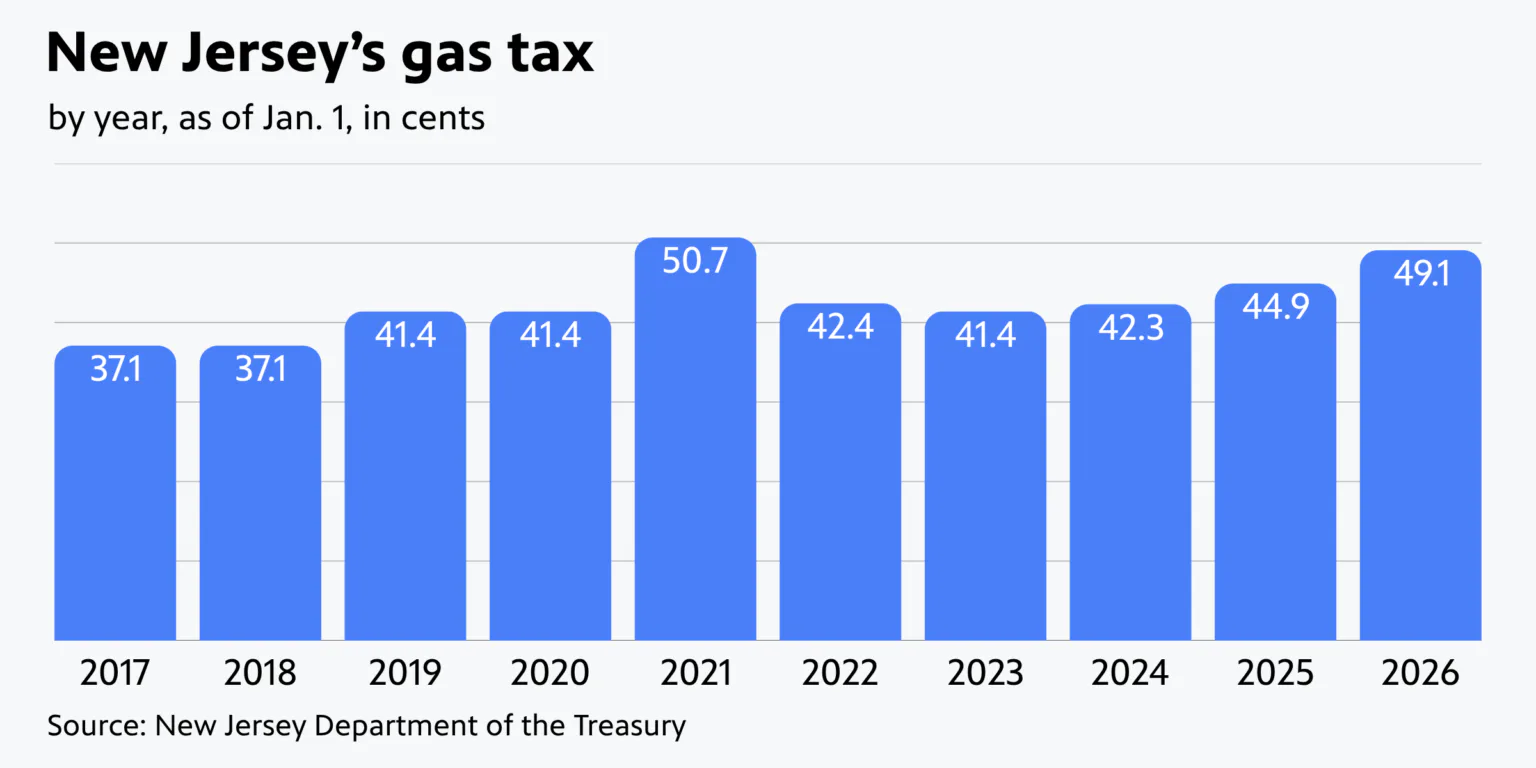
Last year – when a gallon of gasoline sold in New Jersey cost under $3 – the officials decided a rate increase of 4.2 cents was required to go into effect in 2026. That hiked New Jersey’s overall per-gallon tax on gasoline to the current rate of 49.1 cents, and the per-gallon tax on diesel to 56.1 cents.
This year, the government officials, including the state treasurer, are meeting at a time when the average cost of a gallon of gasoline sold in New Jersey has increased to $4.10 in the wake of the war, according to AAA New Jersey.
The cost of a gallon of diesel sold in New Jersey has increased even more over the last year, from $3.66 to $6.33.
Baked into that per-gallon cost are the gas taxes levied by both the federal and state governments. At the federal level, the per-gallon gasoline tax rate is 18.3 cents, and the per-gallon diesel rate is 24.3 cents. The federal gas tax was last changed in 1993.
In New Jersey, this year’s gas-tax meeting comes on the heels of a midterm election that saw Democrats seize on voters’ economic concerns, including the high gas prices, as Democrats scored huge wins, both here and across the nation.
A spokesman for the state Department of the Treasury declined comment on Thursday when asked about this year’s pending decision on the gas tax.
But if Treasury officials stick with past practice, any change in the rate going into effect on Jan. 1 would be announced by early December.
The gas tax explained
New Jersey’s gas tax is the primary source of revenue for the state Transportation Trust Fund, an account separate from the state budget that funds billions of dollars in annual spending on road, bridge and rail infrastructure improvements across the state.
In theory, state law allows for the state gas tax to be kept the same, or even lowered, based on the results of each annual assessment of the latest statewide fuel consumption statistics.
However, a law enacted in 2024 by then-Gov. Phil Murphy and fellow Democrats who control the Legislature made it more likely a series of modest tax hikes would be required over the next several years, pending each annual assessment.
The gas tax was increased by 2.6 cents in 2025, and that hike followed a nearly one-cent increase that went into effect the year before.
In New Jersey, the gas tax is levied on the volume of gasoline or diesel fuel purchased, not as a percentage of the per-gallon price of fuel itself. That means the state collects the same amount of revenue from motorists for every gallon of gas or diesel purchased at the pump, regardless of that day’s price.
The gas tax, which is often referred to in state law as the “highway fuels tax,” is actually comprised of two separate rates levied on the sale of gasoline and diesel fuel. They are the state motor fuels and the petroleum products gross receipts taxes. And revenue from both taxes is constitutionally dedicated to the trust fund, which is often referred to as the TTF.
In 2024, when the trust fund came up for renewal, Murphy and Democratic legislative leaders reauthorized the TTF for another five years, allowing for more than $10 billion in new spending on road, bridge and rail projects.
New rules for EVs
The 2024 reauthorization included several new policy wrinkles, including the establishment of a registration fee for zero-emission vehicles that helps raise additional cash for the ongoing transportation-infrastructure investments.
Initially set at $250 per year, this fee increases by $10 annually until hitting $290 in 2028, according to the reauthorization law.
In addition to the gas tax and the zero-emission vehicle fee, other sources of revenue for the trust fund include a portion of state sales tax revenue and contributions from state toll-road authorities.
Under a prior TTF law, the annual analysis of fuel consumption and revenue data was required to occur by Aug. 15 each year.
But that schedule required rate increases to go into effect each year on Oct. 1, which is often a sensitive time for those seeking state offices. This includes members of the New Jersey Assembly, who run for reelection every other November.
Not surprisingly, lawmakers wrote language into the 2024 reauthorization law that moved the deadline for the annual analysis to Nov. 15. This new schedule also allowed for any required increases to go into effect each year on Jan. 1 — well after Election Day.
Meanwhile, the same reauthorization law also established a series of higher annual highway fuel revenue targets, starting with $2.03 billion during the 2025 fiscal year and increasing to $2.37 billion by the 2029 fiscal year.
At nearly 74 cents per gallon, California levies the nation’s highest state gas tax, while Alaska, at less than 9 cents per gallon, levies the lowest, according to the Tax Foundation’s rankings.