

WASHINGTON — Health insurance premiums for New Jerseyans who receive coverage through the state-run marketplace created under the Affordable Care Act, known as Obamacare, will rise significantly again next year.
Rates in the state’s individual health insurance market, including plans sold through Get Covered New Jersey, will rise by a weighted average of 19.8% in 2027, according to the state Department of Banking and Insurance. That follows an average increase of 15.9% this year.
The increase applies to premiums before financial assistance, and what a consumer ultimately pays will depend on the insurer, the plan, household income, and eligibility for state and federal subsidies.
The sharp rate increases mirror national trends, where hikes are being triggered by a coast-to-coast disenrollment of patients covered within the Obamacare structure, and they lock in the second straight year of double-digit rises in New Jersey.
“What’s driving this first off is the underlying cost of healthcare,” Matt McGough, a policy analyst at KFF, a nonpartisan health policy research, polling and news organization that tracks the 2010 law, said in an interview with NJ Spotlight News.
“If hospital systems charge more money, that gets passed on; new technologies, that gets passed on,” added Neil Sullivan, who was assistant commissioner of the New Jersey Department of Banking and Insurance, which regulates health insurance, from 2010 to 2014.
A sicker pool of patients is also increasing insurance rates, Sullivan said in an interview with NJ Spotlight News: “When you’ve got a risk pool that is a lot of sick people, they are going to be high utilizers of health care, and they’re going to drive high premiums.”
The higher rates next year are likely to place further pressure on health insurance marketplaces nationwide, which saw a decline of nearly 3 million people between 2025 and 2026, as enrollment declined in 49 out of 50 states, except New Mexico, which used state money to fill a federal funding gap.
Enrollment in the ACA marketplace dropped from 21.8 million in 2025 to 19.2 million this year, after Congress chose to allow federal tax subsidies drafted during the COVID-19 pandemic to expire at the end of the 2025 calendar year.
Congressional Democrats held out for weeks to extend the subsidies during an extended government shutdown last year, to no success.
Republican leaders opposed extending the credits, though New Jersey’s Reps. Jeff Van Drew (R-2nd) and Tom Kean Jr. (R-7th) at times voiced their support last fall for keeping the subsidies in place.
“I believe we have a responsibility to do something in the short term,” Van Drew told (opens in new tab) reporters at the time.
A House bill (opens in new tab), which Kean crossed party lines and voted for, never got traction in the Senate and fizzled.
The choice on Capitol Hill to allow the tax credits to expire has become political hay for Democrats. In a September KFF poll (opens in new tab), registered voters list health care as their “top economic” worry, with 60% respondents saying they are either “very” or “somewhat” worried about health care, including insurance prices.
“New Jersey families are already grappling with a serious affordability crisis, and rising medical and prescription drug costs threaten to price residents out of the coverage that they need to stay healthy,” Gov. Mikie Sherrill, a Democrat, said in a statement (opens in new tab).
“The Trump Administration and Washington Republicans have made this crisis worse by allowing enhanced premium tax credits to expire, driving up premiums and forcing families to choose between keeping their coverage and making ends meet.”
In New Jersey, insurance rates for plans on the state-run exchange for 2026 rose 15.9% from the previous year, raising costs for roughly 454,000 people. For 2027, the average increase will be 19.8%, the state Department of Banking and Insurance, which oversees the state’s health exchange, said Thursday.
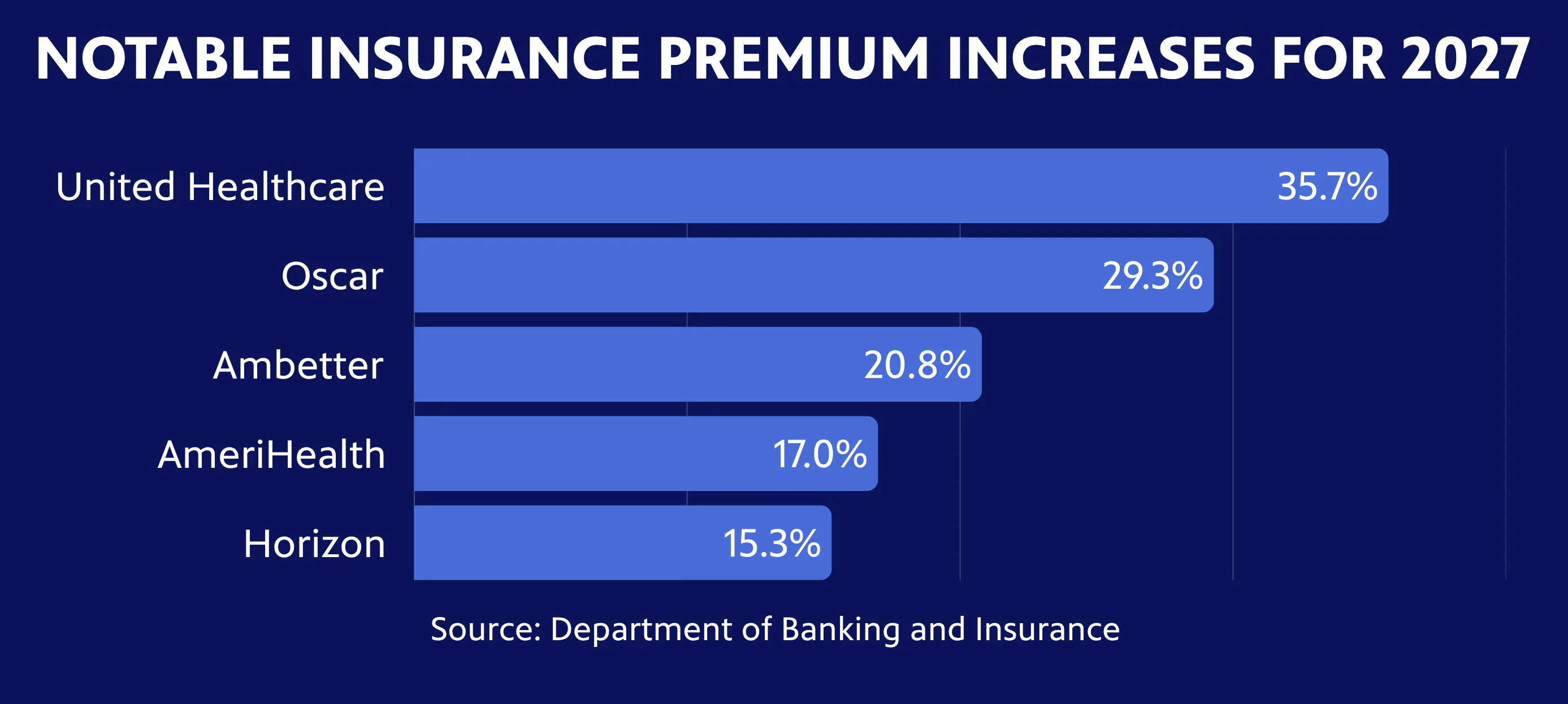
Of the five insurers that offer plans, United Healthcare, a for-profit company that reported more than $4 billion in third-quarter profit this week, will increase the most: 35.7%. United also raised its rates the most of any health insurer in New Jersey for 2026.
The window to enroll for 2027 begins Nov. 1 and runs through Jan. 31, 2027, the department said.
As of June, total state enrollment was 434,700 after nearly 75,000 enrollees (opens in new tab) had fallen out of coverage since the open enrollment period, according to the department.
“The number of lives covered under the fully-insured market has gone down,” said Sullivan, who helped New Jersey implement the 2010 law during the administration of former Gov. Chris Christie.
People buy insurance based on what they think makes sense economically, Sullivan said. In the face of rising prices, some people will take their chances with cheaper coverage or no coverage at all, undercutting the market and further driving up premiums for other people, he said.
“To the extent they stop buying health insurance, that’s a ‘death spiral,’” Sullivan said, using a term medical modelers use to explain this feedback loop. “There’s ultimately no place to go.”
“We’ve seen enrollment fall continuously throughout the year,” KFF’s McGough said of overall coverage under the ACA. “This is sort of the backstop for people in the American health care system.”
Sicker, older and needier patients are going to stay enrolled longer, McGough said. “People who absolutely have to have health insurance.”
Enrollees in the ACA often work in small businesses that don’t provide private insurance or are self-employed, he said.
“These are wage workers and a lot of them are making their own hours,” McGough said. “They make too much money for Medicaid” and are too young for Medicare, the option for seniors.
Stacey Pogue, a senior research fellow at Georgetown University’s Center on Health Insurance Reforms, reads a lot of “rate filings,” documents health insurers file with state insurance agencies to justify their proposed increases.
In the 2027 filings, Pogue said by phone with NJ Spotlight News that the expired tax credits were a dominant reason insurers gave in their paperwork.
“Mostly when insurers were naming a specific policy, they were naming” the expired ACA tax credits, she said. “Those effects weren’t just in one year. They’re going to have ongoing impacts.”
The other big health cut facing the American public is a more than $1 trillion cut to Medicaid from a 2025 tax law the Republican-majority passed. That law is projected to remove about 10 million from health coverage, according to the Congressional Budget Office, a nonpartisan agency that advises Congress on economic matters.
That new law also stripped ACA coverage altogether for several groups of lawful immigrants in the country, including refugees, asylum seekers, domestic-violence victims and those granted “temporary protected status,” or TPS, a protection for people who face dangerous conditions in their home nation.
“Not only is it getting more expensive, but some people will lose coverage,” Pogue said.